

How to Read Fractional Job Posting Hours: What “10 Hours a Week” Really Means
Here’s the thing. That “10 hours a week” looks like a clean boundary, but it is really the start of a conversation, not a contract.
Quick answer: Fractional job posting hours are the client’s estimate of the time the work needs, not a contract or a cap. “10 hours a week” can mean a steady 10, an average, or a hope. Before you say yes, ask how hours are counted, what happens when work grows, and how extra time is paid.
Key takeaways
- Posted hours are an estimate, so ask whether the number is a minimum, a maximum, or an average.
- Scope creep, meetings, and urgent asks can push real hours above the posting, so agree on how extra work is approved and paid.
- Vague scope with a flat fee is the riskiest mix, so get outcomes and limits in writing.
What does “10 hours a week” mean in a fractional job posting?
In a fractional job posting, “10 hours a week” is the client’s estimate of the time the work needs. It is not a guarantee, and it is not always a cap.
Read the words around the number. “About 10,” “up to 10,” and “10 as a minimum” are three different offers. Also check what counts as work: some clients mean focused work only, while others expect calls, messages, and prep to fit inside the same hours.
Weekly patterns also differ by role, and a posting rarely shows them:
- Fractional CFO: hours often bunch around month end, board dates, and fundraising.
- Fractional head of marketing: hours can spike around a launch.
- Fractional HR lead: light weeks can be followed by a hiring burst.
Why do fractional job posting hours and real hours drift apart?
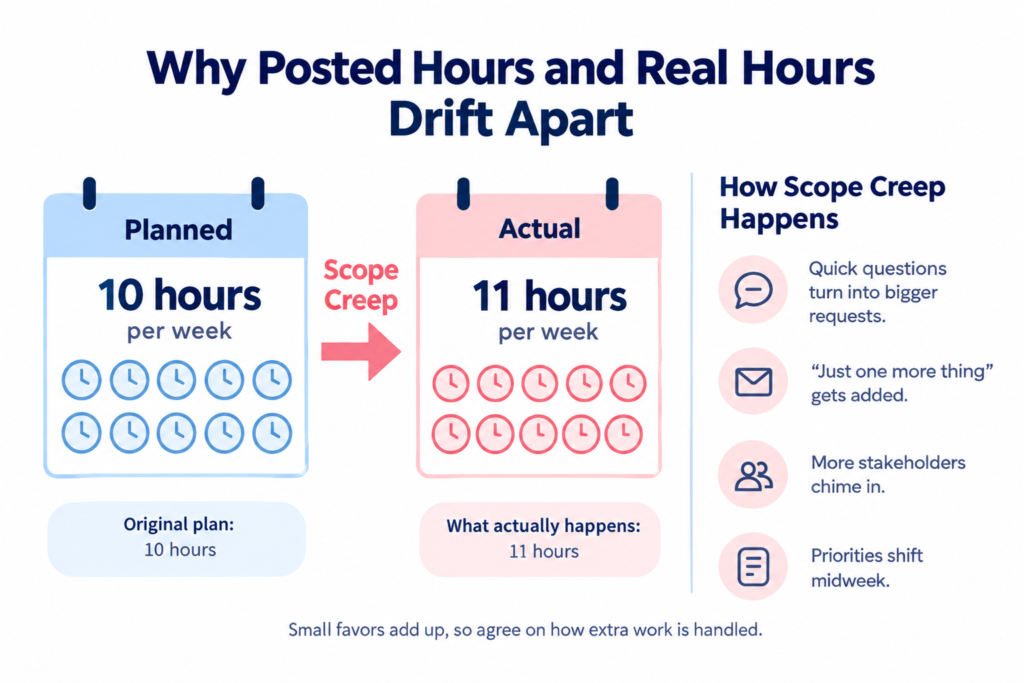
Posted hours and real hours drift apart because the client estimates before the work starts, and new requests arrive after. That slow growth is called scope creep: extra tasks that never get priced or written down.
Scope creep is common well beyond fractional work. PMI’s 2018 Pulse of the Profession found that 52 percent of projects completed in the previous 12 months had scope creep or uncontrolled scope changes. That is a general project figure, not a fractional one, but the pattern will feel familiar.
Four things usually push hours upward:
- The client guessed the hours before knowing your full workload.
- New asks arrive one small favor at a time.
- Meetings, Slack messages, and quick questions go uncounted.
- Several people give you work, but the hours estimate stays the same.
Here is an illustrative example. A posting says 10 hours. You plan 6 hours of core work and 2 hours of meetings. Then 3 hours of quick favors appear, and the week reaches 11 hours before anyone notices.
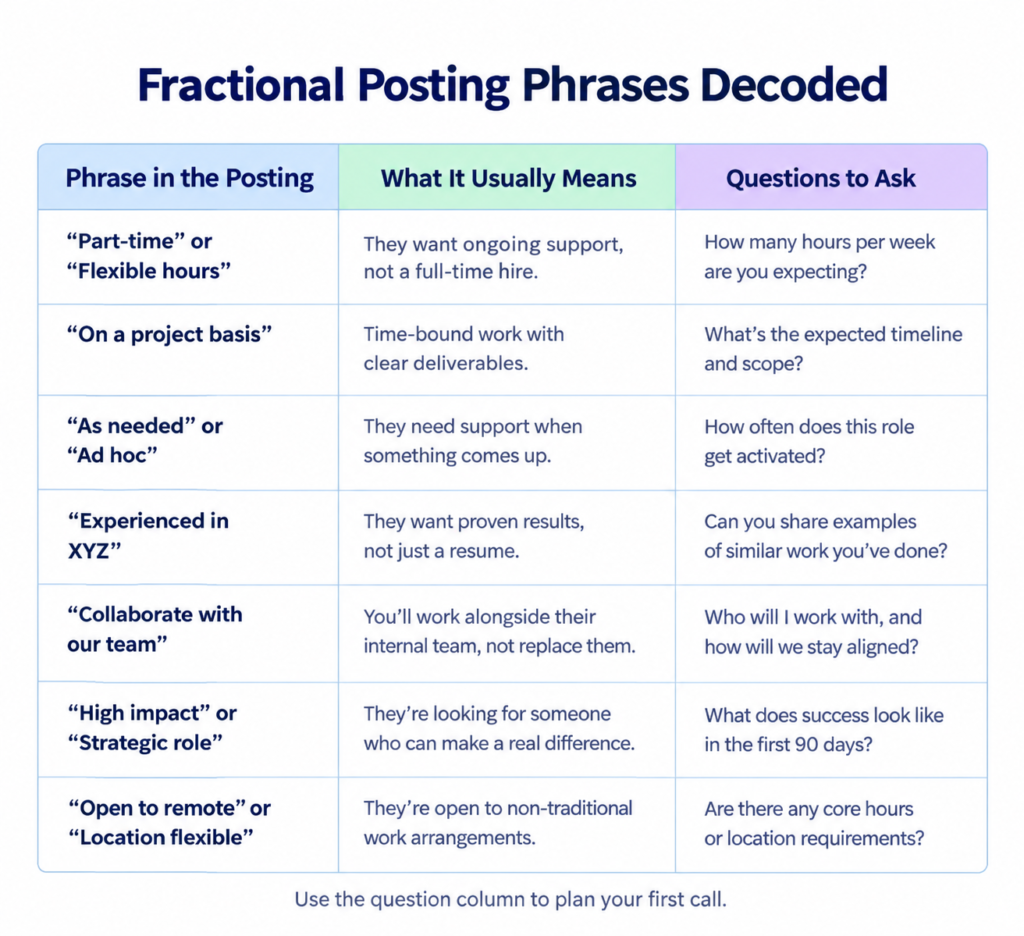
What do common posting phrases really mean?
Posting phrases are shorthand, and the same words can mean different things at different companies. Use the table to decode the wording and pick your questions.
These are general patterns, not verified data.
Which red flags should make you pause?
Pause when nobody can explain how hours are counted, or when the scope is vague and the fee is fixed. Vague scope with a flat fee is where scope creep grows fastest.
- No one can describe a typical week.
- “We will figure out scope as we go,” paired with a flat fee.
- Same-day replies expected on a small hours budget.
- A wide range, such as 10 to 20 hours, with no pricing rule for the top end.
- Set hours, company tools, and detailed instructions, yet the role is called contract work.
That last flag deserves a closer look if you work in the United States. The IRS (2026) says worker status depends on the whole relationship, including behavioral control, financial control, and the type of relationship, and no single factor decides it.
The U.S. Department of Labor (2026) proposed a rule in February 2026 that would treat a worker’s actual practice as more relevant than what a contract allows on paper. A proposal can change or be finalized, so check its current status. Rules also differ by place, so talk to a qualified professional.
What should you ask before you say yes?
Ask how hours are measured, what happens when work grows, and how scope is written down. Do it on the first call, before any trial work begins.
- Is 10 hours a minimum, a maximum, or an average?
- What does a typical week look like, and what did your last busy week look like?
- What should I deliver in the first 30, 60, and 90 days?
- Which meetings are required, and what reply time do you expect?
- How are hours above the posted number approved and paid?
- Who can assign me work, and how is new work recorded?
Then get the answers in writing, even if it is a short follow-up email. When you read new listings on the FindFractionalJobs.com job board, put these same questions to every client.
FAQ
Does 10 hours a week mean I will only work 10 hours?
Not always. The number is often an estimate. Ask whether it is a minimum, a maximum, or an average, and how extra time is handled.
Should I be paid for hours above the posted number?
It depends on your agreement. Hourly billing often covers extra time, while a flat retainer may not. Settle this before you start.
What is scope creep in a fractional role?
Scope creep is when small extra tasks pile up beyond the original agreement. Your workload grows, but your fee and written scope stay the same.
Is it okay to ask about hours on the first call?
Yes. Asking about hours on a first call is normal, and clear answers now prevent surprises later. Good clients usually expect the question.
How do I judge a range like 10 to 20 hours?
Ask what a typical week and a busy week look like. Then ask what triggers the top of the range and how it is priced.
Does the posted hours figure decide if I am a contractor or an employee?
No. The posted hours figure does not decide worker status on its own. Federal agencies look at the whole relationship, including control over how, when, and where you work, so speak with a qualified professional about your situation.
Conclusion
Fractional job posting hours are a starting point, not a contract. A posted 10 hours can shift with scope creep, busy weeks, and unclear terms, so read the words around the number, use the table, and ask direct questions early.
Ready to put these questions to work? Start on the FindFractionalJobs.com homepage or browse listings by job category.
Last updated: September 24, 2026
General information, not legal or tax advice.
