

Fractional Job Scam: 12 Red Flags to Check Before You Apply
The scariest fake listings look completely normal: flexible hours, a fair rate, a friendly recruiter.
Quick answer
A fractional job scam asks for your money, sensitive details, or a rushed decision before any real work begins. A ghost posting is a listing for a role that is not actively being filled, so it wastes your time instead. The 12 red flags below help you spot both.
Key takeaways
- Never pay to get a fractional role, to start work, or to “unlock” earnings.
- Scams push money and speed. Ghost postings show stale dates, vague scope, and silence.
- When something feels off, verify the company on your own and talk to someone you trust.
What is the difference between a fractional job scam and a ghost posting?
A fractional job scam is a fake offer built to take your money or personal data. A ghost posting is a listing for a role nobody is actively filling.
The scale of job scams is real. The FTC says reports of job and employment agency scams tripled from 2020 to 2024, and reported losses jumped from $90 million to $501 million in that period, according to its 2025 fraud data release. Those are reported losses only.
Ghost postings are harder to count. A 2024 Baruch College working paper estimated that up to 21% of job ads may be ghost jobs, using Glassdoor interview reviews. That is an estimate, and it was highest in specialized industries and larger firms.
8 Fractional Job Scam Red Flags to Check First
A fractional job scam usually shows up as a request for money, access, or speed. These eight checks draw on the FTC’s job scams guidance and a 2026 FTC alert.
1. You are asked to pay to get hired
Fees for “training,” “certification,” or “equipment” are a classic trap. The FTC says honest employers never ask you to pay for the promise of a job. Walk away.
2. A check arrives, then you must send money back
You deposit a check, then someone asks you to wire part of it or buy gift cards. The FTC says the check will bounce and your bank will want the full amount back. Do not deposit it.
3. The pay is huge for very little work
Picture a fractional CFO rate for “two easy hours a week” (illustrative). The FTC says a job promising lots of money fast for little work is almost certainly a scam.
4. The offer arrives by text, WhatsApp, or Telegram
An unexpected message says you were “selected” and asks you to reply YES or INTERESTED. In an April 2026 alert, the FTC advised ignoring generic job messages on those channels. Find the company’s official website yourself instead.
5. You are paid to rate or like things, then asked to deposit money
Task scams pay small amounts for ratings or reviews, then ask you to deposit your own money to earn more. The same FTC alert says no honest company pays you to post positive ratings. Do not deposit anything.
6. Sensitive details are requested too early
ID scans, bank logins, or a Social Security number before any signed agreement can lead to identity theft. Share only what is needed, when it is needed.
7. You cannot verify the company or the recruiter
Search the company or recruiter name with “scam,” “review,” or “complaint,” as the FTC suggests. A clean search is not proof of honesty, so confirm the person through the company’s official site.
8. Pressure and secrecy
Messages like “reply today” or “keep this private” often aim to stop you from thinking. The FTC suggests describing the offer to someone you trust, which also buys you time. Take 24 hours before you answer.
4 Ghost Posting Red Flags: Is Anyone Actually Hiring?
Ghost postings often look stale, vague, or oddly quiet, and they cost you time rather than money. The Baruch paper points to the low cost of posting ads and the wish to keep a talent pipeline warm as likely reasons.
9. The posting is old or keeps coming back
The same text reappearing for months can mean nobody is actively hiring. Check the posting date, then ask when the work is expected to start.
10. The scope is a fog
The post names no hours, deliverables, budget, or start date. Ask three questions: how many hours, what the first 90 days should deliver, and when they will decide.
11. No named contact, and the role is missing from the company site
That combination can signal a placeholder listing. Ask who the hiring manager is, then look for the role on the company’s own careers page.
12. The process drags with no next step
In the Baruch study, flagged reviews often described many interview rounds, long waits, and little follow-up. Ask early for the steps and a decision date.
Real Posting vs Scam Posting: Quick Comparison
A real posting is specific about the work and free to apply to. A scam posting is vague about the work and specific about money and speed.
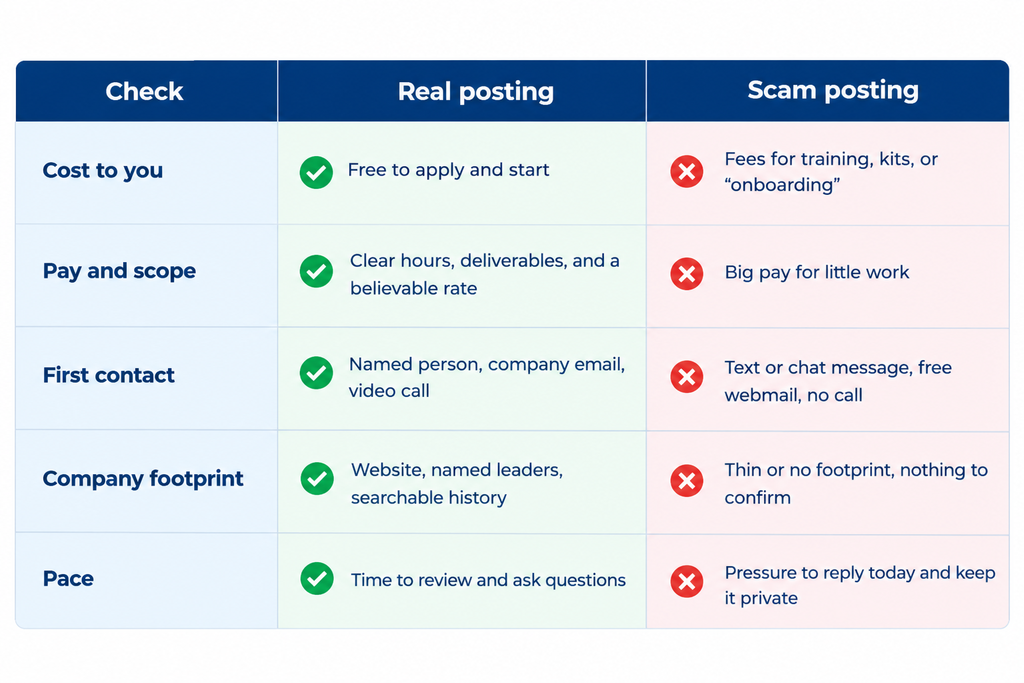
Run a few listings on Browse Jobs through this table. Use the same checks on any site, including ours.
What Should You Do If You Already Shared Information or Sent Money?
Contact the company you used to send the money right away, ask to reverse it, and report the scam to the FTC at ReportFraud.ftc.gov. You can also report it to your state attorney general. The right next step depends on what you shared:
- Paid by bank transfer, card, or payment app: report it to that bank, card issuer, or app and ask for a reversal or refund.
- Paid with gift cards or crypto: contact the gift card issuer or the crypto exchange immediately. Crypto is harder to recover.
- Shared a Social Security number: visit IdentityTheft.gov for a recovery plan.
- Shared account logins: change the password, change any reused passwords, and turn on two factor authentication.
FAQ
These three answers cover what candidates ask most before they apply.
Is it normal to pay a fee to get a fractional role?
No. Honest employers do not charge candidates, so a fee for training, kits, or onboarding is a red flag.
Why would a real company post a role it is not filling?
Researchers point to the low cost of posting ads and the wish to keep a talent pipeline warm. The reasons vary, which is why asking about timing and scope helps.
How do I check a company before I apply?
Search the company name with “scam,” “review,” or “complaint,” and look for the same role on the company’s own website. A clean search is not a guarantee, so keep your guard up.
Spot the Next Fractional Job Scam Before You Apply
The short answer: a fractional job scam pushes you toward money, access, or speed, while a ghost posting stays vague and quiet. Run the 12 checks and slow down.
When you are ready to look at real roles, browse listings on FindFractionalJobs.com or explore job categories. Apply these same 12 checks to every posting you find, including ours.
Last updated: October 16, 2026
General information, not legal or financial advice. If you lost money, contact your bank and report it to the FTC.
