
7 Signals a Startup Is Worth Your Time as a Fractional CFO
Not every startup that posts a fractional CFO role actually needs one. Some need a bookkeeper. Others need a full-time hire but have not admitted it yet. The ones worth your time sit in a specific window: complex enough to require executive financial judgment, but not yet scaled enough to justify a permanent CFO on the payroll.
Learning to spot that window from a job posting or a first discovery call is one of the most valuable skills a fractional CFO can develop. It protects your reputation, keeps your calendar filled with high-impact work, and makes every engagement more satisfying.
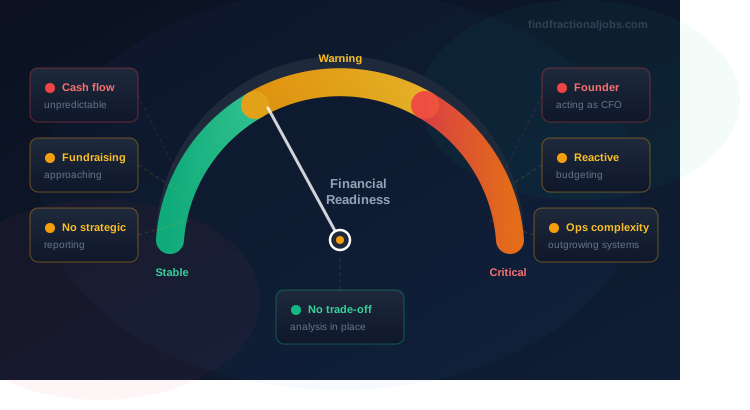
Here are seven financial warning signs that a startup is genuinely ready for fractional CFO leadership, and what each one means for the quality of the engagement you are walking into.
1. Cash Flow Is Unpredictable Despite Revenue Growth
This is one of the clearest green lights for fractional CFO involvement. The startup is generating revenue, maybe even growing quickly, but leadership cannot reliably answer basic questions: How much runway do we have? When will we run out of cash? Why does the bank balance keep surprising us?
Growing revenue does not automatically create financial stability. It often amplifies operational weaknesses. Delayed receivables, misaligned payment cycles, uncontrolled spending, and poor burn tracking all become more damaging as a company scales.
This is a strong fractional entry point because the problem is structural, not fundamental. The business model works. The financial infrastructure does not. CB Insights research on startup failure post-mortems found that running out of cash is the leading cause of startup collapse, and in most cases it is not a revenue problem but a visibility problem. That is exactly what fractional CFO expertise is built to solve.
What to probe in the discovery call: Can the founder tell you their exact monthly burn rate and runway without looking it up? If the answer takes five minutes and three spreadsheets, you have your signal.
2. Fundraising Is 6 to 12 Months Away
A startup preparing for a Series A or B is often the ideal fractional CFO engagement. The timeline creates urgency, the stakes are high, and the work is squarely in your wheelhouse: financial models, investor-grade reporting, data room preparation, cap table cleanup, and board deck support.
Investors at growth rounds are no longer evaluating potential alone. They want precision. They want auditable financials, clean unit economics, and a coherent narrative about how capital will be deployed. A founder who cannot confidently explain their blended customer acquisition cost or gross margin by segment is going to struggle in due diligence.
A fractional CFO who comes in six months before the raise gives the company enough runway to fix what needs fixing before investors see it. Coming in two months before is damage control. Coming in six months before is strategy.
3. The Founder Is Still Acting as the CFO
This might be the most common signal of all, and it is one of the strongest indicators of genuine need.
Many founders manage the finances by necessity in the early days. That arrangement works fine when the business is simple. It breaks down when complexity arrives. A founder who is also running product, hiring, investor relations, and customer growth cannot give financial strategy the attention it deserves. Decision quality quietly deteriorates.
According to Fidelity Private Shares’ 2026 CFO Landscape Report, 87% of startup CFOs now manage functions beyond finance, including legal, HR, and operations. When a founder is absorbing all of that on top of running the company, something is always being neglected. Usually it is financial strategy.
This engagement type works best when the founder genuinely wants to hand off financial oversight, not just get someone to validate their existing spreadsheets. Probe for that distinction early.
4. Financial Reporting Exists But Provides No Strategic Insight
The startup has a bookkeeper. The books are closed monthly. A P&L gets emailed out. Nobody knows what to do with it.
This is a classic fractional entry point. Basic accounting infrastructure exists, but nobody is translating the numbers into decisions. Which customer segments are actually profitable? Are margins compressing as headcount grows? Is the pricing model sustainable at scale? These questions go unanswered because the company has bookkeeping, not financial leadership.
The gap between recording what happened and understanding what it means is exactly where fractional CFO value lives. If the monthly close happens on time but the leadership team still feels financially blind, that is your opening.
5. Budgeting Has Become Reactive
Watch for startups where financial decisions consistently happen in response to problems rather than ahead of them. Hiring decisions made without modeling the impact. Budget overruns handled with emergency cost-cutting. Vendor payments delayed because cash timing was not tracked. Product launches approved without profitability analysis.
This reactive pattern is not laziness. It is what happens when a company scales past the point where one person can hold the financial picture in their head. The business needs a system, and the system needs an experienced architect.
A fractional CFO who can build a rolling forecast, establish spend accountability by department, and connect budget decisions to strategic outcomes transforms this dynamic. It is high-impact work that produces visible results within 60 to 90 days, which is exactly what a good fractional engagement looks like.
6. Operational Complexity Has Outgrown Internal Systems
New revenue streams. Enterprise customers with custom pricing. Remote teams across multiple states or countries. Deferred revenue. Intercompany transactions. These are all signs that a startup has grown into genuine financial complexity.
The processes that worked at ten employees and two product lines do not work at fifty employees and six. Manual tracking breaks. Reconciliation takes days instead of hours. Compliance obligations quietly multiply. Month-end closes take longer every quarter.
Fractional CFOs who have built finance infrastructure for scaling companies bring an enormous advantage here. They have seen these problems before. They know which systems to implement, which processes to standardize, and which shortcuts will cause problems later. That pattern recognition is worth more than any hourly rate suggests.
7. Strategic Decisions Are Being Made Without Financial Trade-Off Analysis
This one shows up in leadership conversations before it shows up in the numbers. The team debates whether to hire more engineers or expand the sales team. They weigh entering a new market against doubling down on the existing one. They consider a pricing change without knowing how it will affect churn or lifetime value.
These are the right questions to be asking. The problem is when the answers are driven by gut feeling, competitive pressure, or whoever made the most compelling argument in the last meeting, rather than by financial modeling.
A fractional CFO introduces scenario analysis, trade-off modeling, and capital allocation discipline into strategic conversations. They do not take over the decision. They give leadership the financial clarity to make it confidently. That shift, from financial anxiety to financial confidence, is one of the most tangible things a fractional CFO delivers.
How to Use These Signals to Evaluate Postings
You do not need to see all seven signs to pursue an opportunity. Two or three that align with your specific expertise and available capacity are enough. The sweet spot is a startup that has clearly defined financial problems, a founder who understands they need strategic help, and enough operational foundation for fractional guidance to add real value.
Questions worth asking in every discovery call
- What is your current monthly burn rate, and how confident are you in that number?
- How much cash runway do you have under your current projections?
- What specific outcome would make this engagement successful in six months?
- What financial infrastructure and team capability do you have in place today?
Companies that cannot answer the first two questions need financial infrastructure before they need financial strategy. Companies with clear answers and defined outcomes are ready for the kind of fractional engagement that builds your reputation.
Red Flags That Override These Signals
Even if a startup shows several of the warning signs above, certain patterns predict difficult engagements regardless of the financial need.
- Founder who wants validation, not insight. They already know the answer they want. Your job would be to justify it financially.
- Expectations of full-time output at fractional hours. If the scope does not fit the time commitment, the engagement will fail.
- No path to either profitability or fundraising. Better financial reporting cannot save a broken business model.
- Equity-only or equity-heavy compensation. You bring immediate value. You should be paid immediately.
Bottom Line
The best fractional CFO engagements are not just about financial need. They are about timing. A startup that genuinely needs strategic financial leadership, has the operational foundation to act on your recommendations, and has a founder who is ready to partner rather than micromanage is the opportunity worth pursuing.
Use these seven warning signs as your filter. They will not just help you find better engagements. They will help you have better conversations, set clearer expectations, and deliver the kind of results that build a fractional practice worth having.
